
ChefKD's Message to a New Generation: Africa Does Not Need Reinvention. It Needs Remembrance.
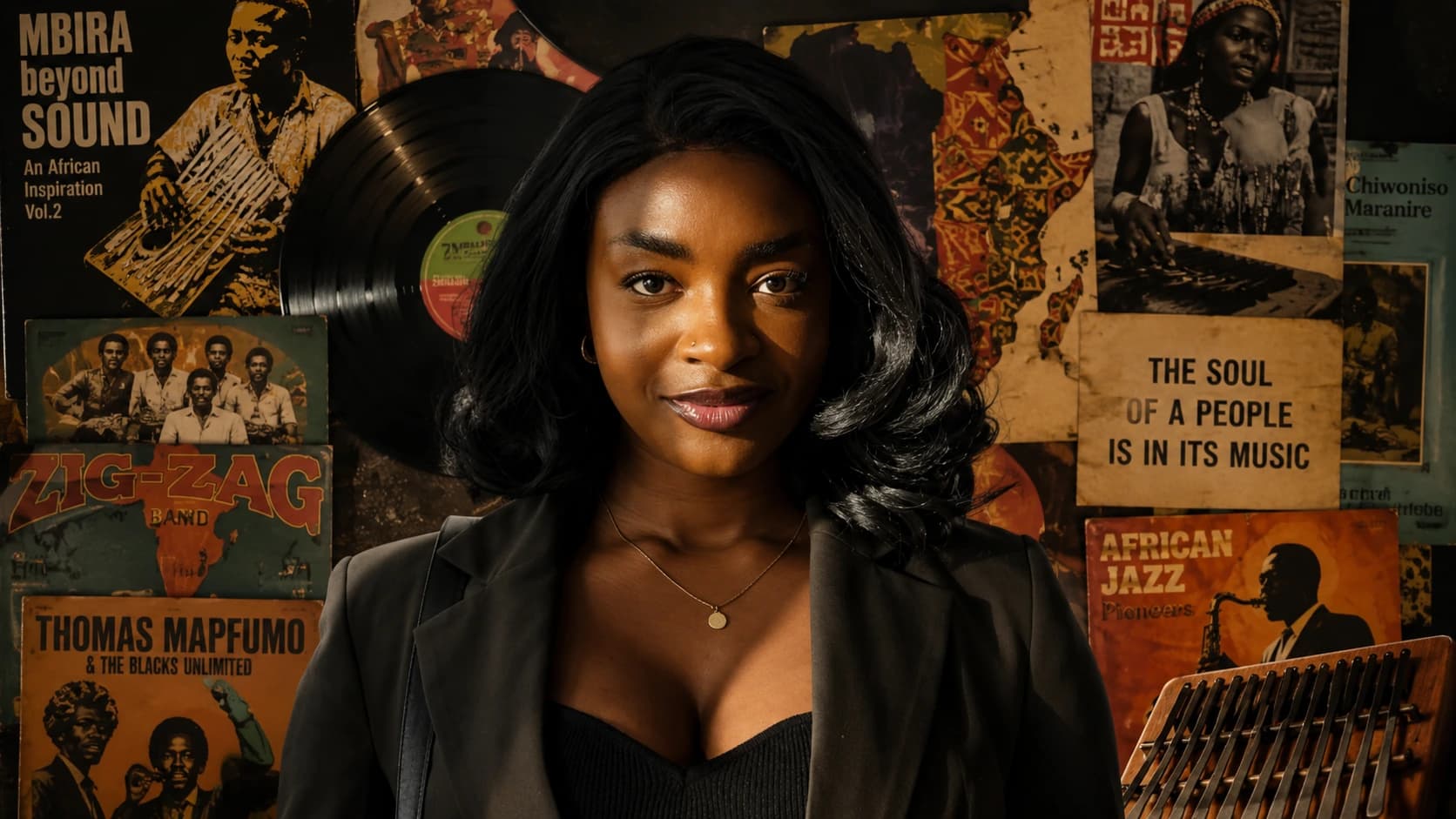
The article discusses the importance of remembering Africa's cultural heritage and history, emphasizing the work of Kudiwa Natalie Shonhiwa in preserving Zimbabwean music and stories.
Written by
Battora Editorial Team
Africa Does Not Need Reinvention. It Needs Remembrance.
The modern African story is often told as one of catching up.
We are told that progress lies elsewhere. That the future arrives from Silicon Valley, from London, from New York. We import technologies, business models, education systems and even artistic identities, hoping they will solve problems that have become uniquely ours.
Yet perhaps one of Africa's greatest challenges is not a lack of innovation.
Perhaps it is forgetting.
Zimbabwean cultural archivist Kudiwa Natalie Shonhiwa, through her platform ChefKD, spends her time documenting old records, forgotten bands, the origins of instruments and the hidden histories buried inside Zimbabwean music. At first glance, it looks like music journalism. But the deeper you look, the clearer it becomes that she is doing something much larger.
She is preserving memory.
Her work begins with a simple understanding: music does not emerge from nowhere. It is born from people, from struggle, from joy, from displacement, from spirituality and from survival itself.
Zimbabwean music was shaped by liberation wars, colonial rule, segregation and the resilience of ordinary communities. Songs carried stories long before books could reach villages. Melodies became libraries. Rhythm became oral history.
Long before archives and museums, our ancestors encoded knowledge into sound.
The mbira was never simply an instrument. It was a bridge between worlds. It carried prayers. It connected families to ancestors. It gave communities a way to preserve continuity between generations. Even today, one can hear the mbira being played in churches, concert halls and cultural festivals across the world. Entire communities in places as far as Brazil have embraced it.
But Kudiwa raises an uncomfortable question.
What happens when an instrument survives, but its meaning disappears?
What happens when people know the melody but forget the message?
An instrument without its story becomes decoration.
A culture without its memory becomes performance.
This may be one of the defining challenges facing Africa today.
The internet has given us access to everything, yet it has quietly encouraged us to forget ourselves. Young Africans can recite the history of American hip-hop, identify the birthplaces of rock music and follow every global trend in real time. Yet many would struggle to explain where their own musical traditions came from, why certain ceremonies existed or what their grandparents understood about the world.
This is not because those stories lack value.
It is because they are not being told.
Living in Canada sharpened Kudiwa's appreciation for Zimbabwe. Surrounded by people deeply connected to their own histories, she began asking herself a simple but profound question:
If I do not tell the story of my country, who will?
It is a question that extends beyond music.
Who will tell the story of African science before colonialism? Who will preserve indigenous systems of governance, healing and education? Who will explain why certain rituals existed, why communities were structured the way they were, or why our ancestors built the societies they did?
Too often, Africa is presented as though history began when someone else arrived to document it.
Yet our ancestors engineered instruments capable of producing precise frequencies. They developed systems of communal governance that kept societies together for centuries. They understood agriculture, astronomy and medicine in ways that modern research is only beginning to revisit.
Perhaps the answers to many of our present challenges are not waiting to be invented.
Perhaps they are waiting to be remembered.
This is not an argument against progress.
Africa has always evolved. Cultures borrowed from one another, adapted and fused new influences into existing traditions. Kudiwa herself speaks passionately about blending Zimbabwean identity with hip-hop, electronic music and modern production.
But fusion is not imitation.
"When you grow up with a certain sound," she explains, "you have a mastery of it that no one else can have."
That idea extends far beyond music.
No one understands African communities quite like Africans do. No one fully understands the emotional weight carried by our ceremonies, our stories, our languages and our rhythms. These things are not obstacles to modernity. They are the raw materials from which our future can be built.
Yet modern life encourages amnesia.
Streaming replaces ownership. Algorithms replace archives. Trends replace tradition. We move so quickly that we rarely stop to ask where we came from.
Vinyl, for Kudiwa, represents the opposite philosophy. A record asks you to slow down. To hold the music. To read the liner notes. To learn who created it and why. It transforms listening from passive consumption into active participation.
In many ways, that is exactly what Africa must do with its own history.
We must stop consuming ourselves passively.
We must study ourselves.
We must document ourselves.
We must preserve the stories that previous generations entrusted to us.
Because culture is not simply food, fashion or music.
Culture is inherited memory.
It is the accumulated knowledge of thousands of years, passed from one generation to the next through songs, stories, rituals and symbols. It is a map showing where a people have been, what they survived and what they believed was worth carrying forward.
A people without memory become dependent on the memories of others.
A people who forget their stories begin to borrow identities that were never theirs.
And perhaps that is why the work of people like Kudiwa Natalie Shonhiwa matters so deeply.
She is not simply documenting old records.
She is protecting a conversation between ancestors and descendants.
Because before Africa can build its future, it must first remember that it has one of the richest pasts the world has ever known.
Related stories


Read next
Everyone Is Talking About AI. Marcus Tawanda Gora Thinks We're Missing the Point.
The conversation with Marcus Tawanda Gora emphasizes the importance of perspective in technology, particularly regarding AI and its impact on creators in Africa.
Continue reading